”In the old days, it was about producing to meet a need. Today, it is about being able to off-take the production”
11. January 2023
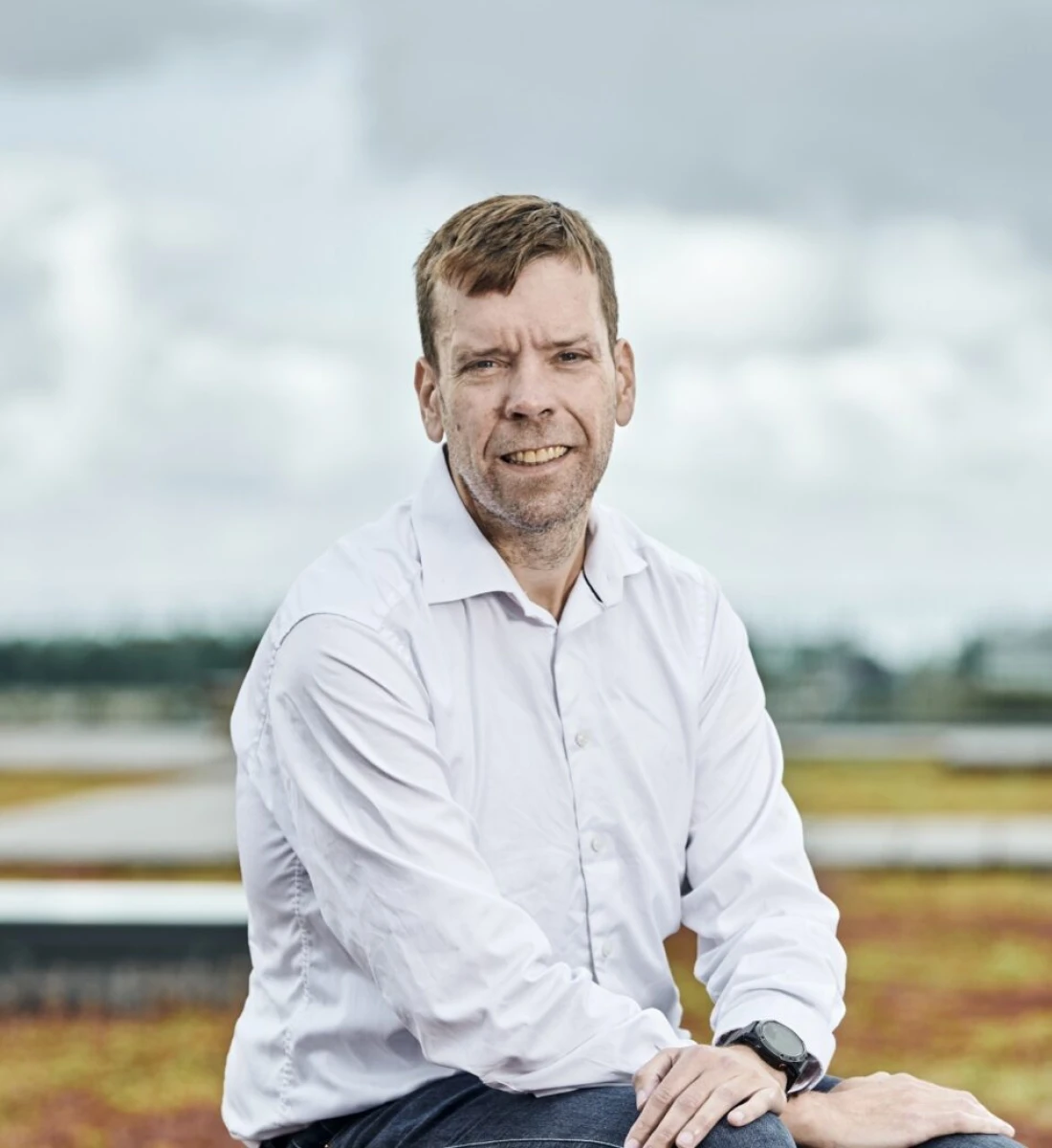
Business Development Manager Claus A. Nielsen from DIN Forsyning feels ’blessed with infrastructure’ and dreams of making Esbjerg and the surrounding area into a large battery. ”In the energy system of the future, it will be more important to be able to off-take electricity than to be able to produce it,” he says
Business Development Manager Claus A. Nielsen from DIN Forsyning feels ’blessed with infrastructure’ and dreams of making Esbjerg and the surrounding area into a large battery. ”In the energy system of the future, it will be more important to be able to off-take electricity than to be able to produce it,” he says
Photo: Christer Holte.
When the world’s utility companies want to become wiser about green transition and sector coupling, they look to Denmark and often to Denmark’s Energy Metropolis. Because there are two areas where Esbjerg is far ahead – both internationally and nationally: Creating a coherent energy and supply system, and basing that system as much as possible on renewable energy.
It is about sector coupling, about efficiency, and about increased integration of renewable energy sources, and it is about daring to take new paths and helping to shape the innovation that makes it all possible, says DIN Forsyning’s Business Development Manager, Claus A. Nielsen:
– In the old days, it was about producing to meet a need. Today, it is more about being able to off-take according to production. The task as a utility company has turned 180 degrees, and the ability to absorb that change is the key to succeeding with the green transition. And here we are very far along in Esbjerg, he says.
"The ability to absorb that change is the key to succeeding with the green transition. And here we are very far along in Esbjerg."
Claus Nielsen
Business Development Manager, DIN Forsyning
New Mentality
Supply infrastructure has previously been geared towards a product, e.g., producing heat and electricity by burning something at a combined heat and power plant.
– In a new, sector-coupled reality, we as a supply company must first and foremost provide flexibility in the electricity system, says Claus Nielsen:
"We must be able to turn on the heat pump when there is a lot of electricity, so, for example, on a windy weekend we can produce heat and store it in the system, so we utilize the energy instead of shutting down the wind turbines."
Claus Nielsen
Business Development Manager, DIN Forsyning
– That way, we become a large battery, where we use the weekend’s wind to ensure that there is heat in schools, shops, and businesses Monday morning, and that we utilize the capacity and flexibility in the system as a battery, he says:
– In the old days, we had a power plant that produced electricity – now we have a heat pump that uses electricity. It is a new mentality, Claus continues.
Standing on the Shoulders of Past Heroes
The foundation largely involves utilizing the legacy that lies beneath Danish residential streets. Over the past 50-60 years, we have made a coherent energy system into a unique Danish discipline and core competence, and in a modern energy supply, it is a gift that keeps on giving:
– In Denmark, we are blessed with an excellent energy and supply infrastructure, which we largely take for granted and do not appreciate enough. Many of the breakthroughs currently happening in the energy and supply sector are based on having thought things through carefully and created long-term solutions, says Claus Nielsen:
"When we can tour around Europe and tell about the green transition on top of heat supplies, it is because sector coupling and green transition on this scale require efficient, flexible infrastructure – and we have that at home."
Claus Nielsen
Business Development Manager, DIN Forsyning
Infrastructure Must Do More
The coherent infrastructure makes the coupling, which is so important, possible. With an increasing renewable energy production from North Sea wind turbines, there is a need to be able to use more electricity for more things – that there are more potential off-takers of electricity.
Therefore, DIN Forsyning has invested in creating Denmark’s largest seawater heat pump at 50 MW. The pump uses electricity from offshore wind to extract heat from seawater and heat it up to the 65 degrees that district heating customers need. Not unlike a geothermal heat pump, for example.
– We have 2,400 MWh in accumulation tank via the seawater heat pump corresponding to the electricity production of 250 offshore wind turbines for one hour. We can burn 60 MW of each hour as extra consumption. That gives flexibility,” says Claus Nielsen.
Flexibility is the key:
– We think of infrastructure as something that can do more than one thing. Our strategy is that we preferably want to make investments that have multiple purposes. So when we invest in heating pipes, they must be able to deliver flexibility to the power grid, heat to you at home, and cooling to businesses, the development manager says.
"We are a trading post for energy, The Blue Book for utilities."
Claus Nielsen
Business Development Manager, DIN Forsyning
Trading Post for Energy
Another focus area is to be more efficient, manage, and consume smarter – for example by letting surplus heat from businesses enter district heating and using treated wastewater as a water source for PtX plants.
It can also be sorting 160,000 tons of mixed plastic waste annually for recycling, as the Norwegian company Quantafuel works with:
– If we can help transform our collected plastic waste into new oil, which can be used for new plastic, then we are far ahead, especially if the heat from the processes is utilized, says Claus A. Nielsen.
The collaboration between the public utility and private companies is an important part of the common calculation: When Cocio, for example, needs to get rid of its process heat, it can happen with coolers powered by the utility. The heat removed is not wasted – it ends up in the district heating system.
– The smart thing is that we can deliver a cooling service where it is needed – without using electricity for it. At the same time, we can move the heat to where it is demanded. We are a trading post for energy, The Blue Book for utilities, says Claus A. Nielsen.
A Potential Business Venture
It is not just smart, but really smart. Because when Claus cools process companies down using the residential street, the Esbjerg resident gets a cheaper heating bill.
– I get paid by the company to cool them down, and out on the residential street, you want the heat. So I deliver a solution in both places but basically only redistribute the energy. That means there is a lower total cost, and it makes both cheaper, says Claus Nielsen.
And it benefits not only the residential street.
– The coherence in the energy system means that it can be more energy-efficient to produce a ton of ammonia in Esbjerg than in many other places, because we can both supply green electricity and phase out surplus heat in the grid. That creates the basis for a potential business venture, says Claus A. Nielsen:
– And the possibilities are many. As a trading company, we can trade temperature differences but also water needs and exchange wastewater from one place with treatment capacity from another by utilizing the well-developed infrastructure that we are blessed with in Esbjerg, Varde, and Nordby, he says.
– One of the things that surprises the most when foreigners come to see our facilities is that we have both managed to integrate renewable energy effectively into the system and at the same time managed to maintain a supply security of 99+ percent. That surprises foreign guests, says Claus A. Nielsen.
"We have both managed to integrate renewable energy effectively into the system and at the same time managed to maintain a supply security of 99+ percent. That surprises foreign guests."
Claus Nielsen
Business Development Manager, DIN Forsyning