From fishing village to world-leading energy metropolis
11. June 2019
Esbjerg Harbor is Denmark's largest offshore harbor and the world's leading port for the shipment of wind turbines.
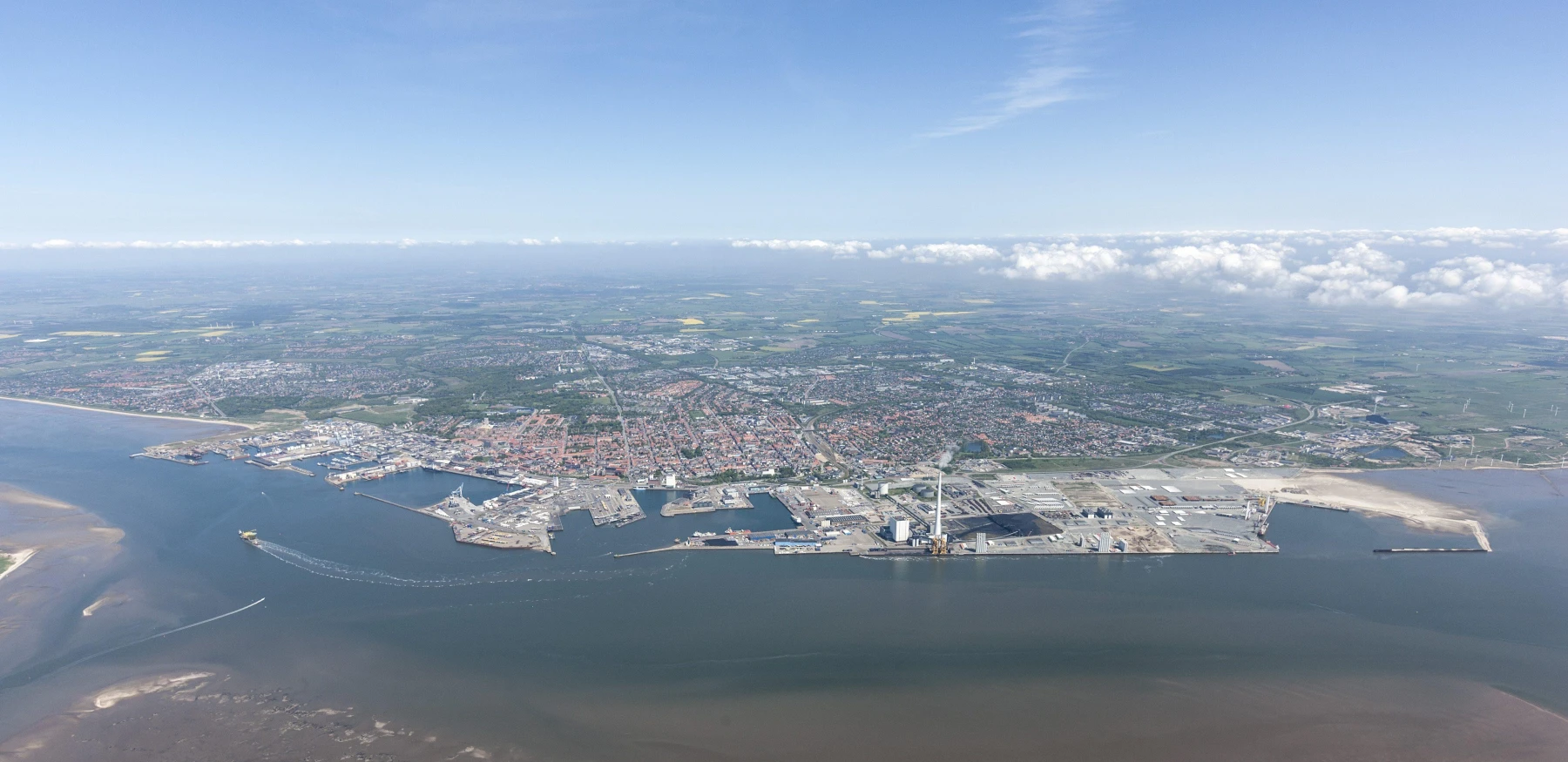
In 1868, it was decided to build a 250-meter quay in the area now known as Esbjerg Harbor – and within a few years, the city grew from 23 to 13,000 inhabitants and became known as Denmark's Chicago. Just over 150 years later, the historic entrepreneurial spirit can still be felt in what is today Denmark's offshore capital.
Even on a foggy winter day, the view from Esbjerg's East Harbor over the city is quite impressive. Along the quay, the enormous offshore wind turbines stand ready for shipment – as a kind of symbol of a green future, according to the former director of Esbjerg Harbor – while the smoking chimney from the power plant can be seen in the background – perhaps as a symbol of the past.
– That very view is what Esbjerg should be most proud of. It is an image of the green transition that the city has been a driving force for, which has resulted in growth, jobs, and internationalization in the city. Just over ten years ago, this was seabed, says Ole Ingrisch, while showing around the harbor area, which is built specifically for the wind turbine industry and has cost more than 1.5 billion kroner to construct.
"It is an image of the green transition that Esbjerg has been a driving force for, which has resulted in growth, jobs, and internationalization in the city"

Ole Ingrisch
Former Director Esbjerg Harbor
City by chance
When driving along the 12 km of quay that today make up Esbjerg Harbor, it is hard to imagine that the harbor is a result of coincidences.
– After the war in 1864, where Denmark lost the duchies, a new West Jutland harbor had to be established. The choice fell on Esbjerg because the sea quickly became deep here – and that was essential at a time when the contractor tools consisted of shovel, spade, wheelbarrow, and horse-drawn carriage. Back then, the city had only 23 inhabitants, explains the head of Esbjerg City Historical Archive, Jørgen Dieckmann Rasmussen, about the construction of the then 250-meter harbor quay, which was completed in 1874.
– Along with the harbor came the railway, which was to transport livestock that was to be shipped further. But from 1879, agriculture was reorganized, and in that context, the harbor became an important player – both for import and export. Esbjerg became a major exporter especially of bacon, butter, and eggs to the United Kingdom. At the same time, fishing emerged as a profession, and already in 1901, over 13,000 people lived in Esbjerg, which had now become a real market town with inhabitants from America, Sweden, Norway, and Germany, he reports.
Denmark's Chicago
The rapid development at the end of the 1800s and the beginning of the 1900s gave Esbjerg a reputation as Denmark's Chicago.
– Esbjerg became known as the city of opportunities: If you had a good idea, it could be realized here. For some, Esbjerg was an alternative to the long journey across the Atlantic, while others ended up settling here on their way to America. When large stocks of plaice were discovered at Horns Rev, the fishermen also moved to the area. That meant that in the 1960s, Esbjerg became one of Europe's largest fishing towns, explains Morten Hahn-Pedersen, who is an author, researcher, and former director of the Fisheries and Maritime Museum in Esbjerg, about the next growth leap in the city's business sector, which strongly influenced urban development:
Esbjerg is Denmark's sustainable energy metropolis
– The city expanded, and several of the small surrounding village communities became part of the city itself, which in those years also gained residential neighborhoods, suburbs, and industrial districts. But Esbjerg was still a seafaring and fishing town. The city only really changed when oil activities took off with the development of the large oil fields in the 1980s and the massive expansion in the 1990s – and then further when the green offshore and offshore wind turbines arrived in the 2000s. The offshore industry's increased need for highly educated employees made it necessary to build music halls and other cultural institutions. So it is that development that over 20 years transformed Esbjerg from a fishing town to a cultural city, reports Morten Hahn-Pedersen.
From unskilled to high-tech
The result of that development can be seen all over the city, which just over 150 years ago was only two farms and three houses. But it is especially evident at the harbor.
– Esbjerg has become Denmark's offshore center within wind, oil, and gas. We are not only Denmark's leading port for offshore wind installation, which has an export value close to 100 billion kroner – we are the world's leading port in that area. It has attracted many multinational companies, and it has radically increased the activity level, says Ole Ingrisch while also pointing to the shift that has happened in the composition of jobs:
– In the 1990s, the harbor primarily housed unskilled jobs related to fishing. Today, nearly 200 companies have an address at the harbor – including many high-tech jobs that, among other things, demand skilled engineers, technicians, and highly educated craftsmen.
Green transition must create growth
Recent years have brought several good news stories that bode well for Esbjerg's future. In mid-2020, the Swedish infrastructure fund Infranode announced that they – together with Esbjerg Harbor – would invest about 1 billion green kroner in the development of the offshore wind industry in Esbjerg.
This was later followed by the government's adoption of the establishment of a historic energy island with wind turbines in the North Sea of 3 GW. That means it will be more than three times as large as the wind turbines currently installed in the Horns Rev 1, 2, and 3 parks off Esbjerg.
Additionally, Copenhagen Infrastructure Partners has announced that Europe's by far largest Power-to-X plant could be a reality in Esbjerg in five years, as they plan to build a facility that from 2026 will be able to produce 800-900,000 tons of green ammonia annually via a 1 GW electrolyzer.
– These news are good examples of the green transition that our area, our harbor, our municipality, and our companies are already fully engaged in. We have an incredibly strong starting point and potential that must be utilized. That can help cement Esbjerg as a sustainable energy metropolis and can become the next big chapter in our business history, which can add growth and thousands of new jobs to the entire region, says Business Esbjerg chairman Flemming N. Enevoldsen.
Global internet harbor
Alongside Esbjerg's progress in offshore wind and offshore, Denmark's fifth-largest city today is also developing into a Nordic hub for data traffic. The submarine cables COBRA, which connect Esbjerg and the Netherlands, as well as Havfrue – a 7,000 km transatlantic fiber cable between Esbjerg and New Jersey – have attracted global internet giants to set course for the city.
– Besides the physical harbor, we now also have an "internet harbor" that connects Esbjerg with the whole world. Now Esbjerg is truly on the digital map, explains Business Esbjerg's business manager Karsten Rieder, who calls the recent years' digital development the starting shot for Esbjerg's "new big business adventure."
– It's not only IT companies that need good data connections. For example, all companies that need to have data stored in the cloud – i.e., everything from internationally oriented companies to web hosting and app developers – will benefit from being close to an internet hub that ensures the best and most optimal connection. So we expect it to have a strongly positive effect on the city's business life and employment for many years to come, he says.
The DNA of Esbjerg residents
Across the rapid development and the many changes Esbjerg has undergone as a harbor and city, the residents of Esbjerg have always had one thing in common, regardless of year and generation, explains Jørgen Dieckmann Rasmussen:
– The Esbjerg DNA. The people of Esbjerg have always been adaptable, resilient, stuck together, and had an openness to the world. Ever since the harbor was established, the city has lived off contact with abroad – and that still characterizes the atmosphere in the city today, he says.
This "DNA" has also been noticed by the harbor director, who himself is an immigrant from Copenhagen.
– You can still feel the entrepreneurial and pioneer spirit that the newcomers had one and a half centuries ago. The people of Esbjerg are risk-taking, entrepreneurial, and hardworking – and at the same time modest. In fact, I believe that many of the things that gave the people of Esbjerg success with fishing – being tough and able to work in all kinds of weather – also have a big share in the city's success today, believes Ole Ingrisch, who is supported by Morten Hahn-Pedersen:
– In Esbjerg, nothing is impossible. Here, impossible just means that it takes a little longer, he points out with a smile on his lips.